Jonathan Latiano @ Hawthorn Contemporary
All Things Are Big and Small With Jonathan Latiano
May 9, 2026 – August 22, 2026
Humans occupy the spatial midpoint of the universe. The size ratio between elementary particles such as neutrinos and the human body is similar to the ratio between our bodies and the observable universe. The planet we inhabit is approximately a third of the age of the universe. Because our spatial and temporal frames of reference are far from the ends of both scales, we struggle to grasp phenomena that are not proximate.
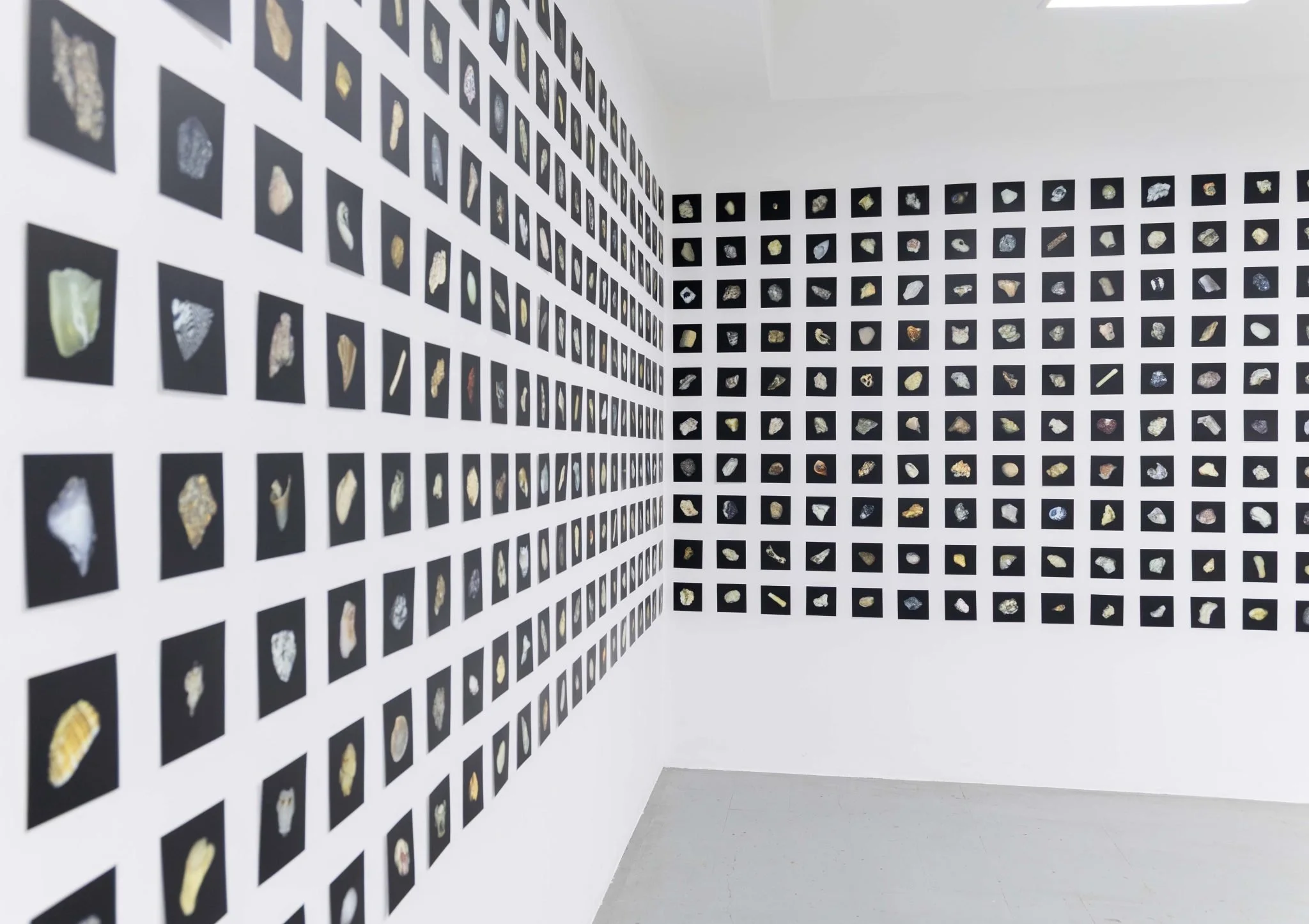
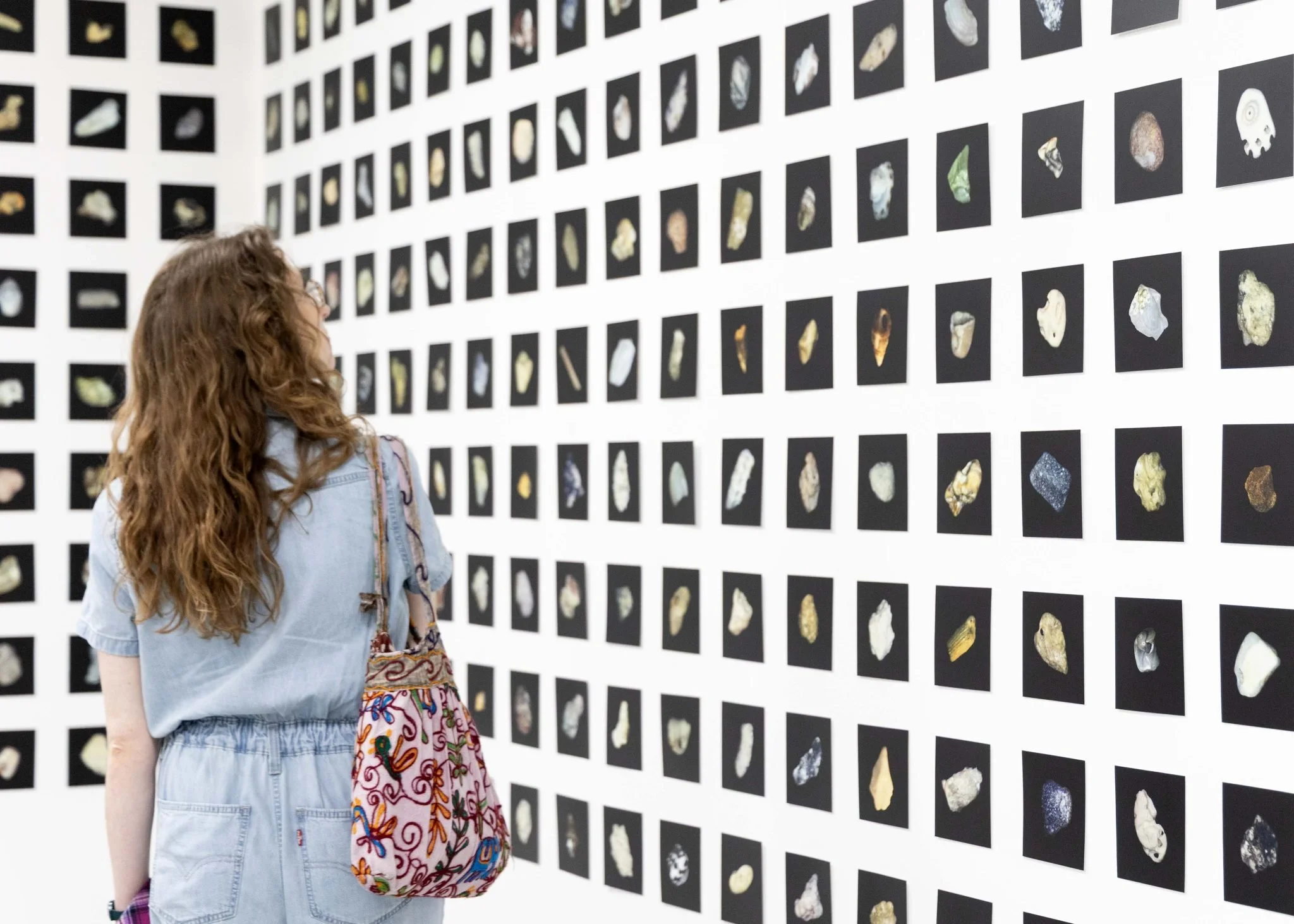
Massachusetts artist Jonathan Latiano embraces this perceptual and conceptual challenge in his poetically cerebral exhibition, “Scaling a Pyramid,” on view at Hawthorn Contemporary in Milwaukee. The project comprises 2,238 photographs of individual sand grains the artist collected from a Jamaican shoreline, together with one sculpture and four drawings.
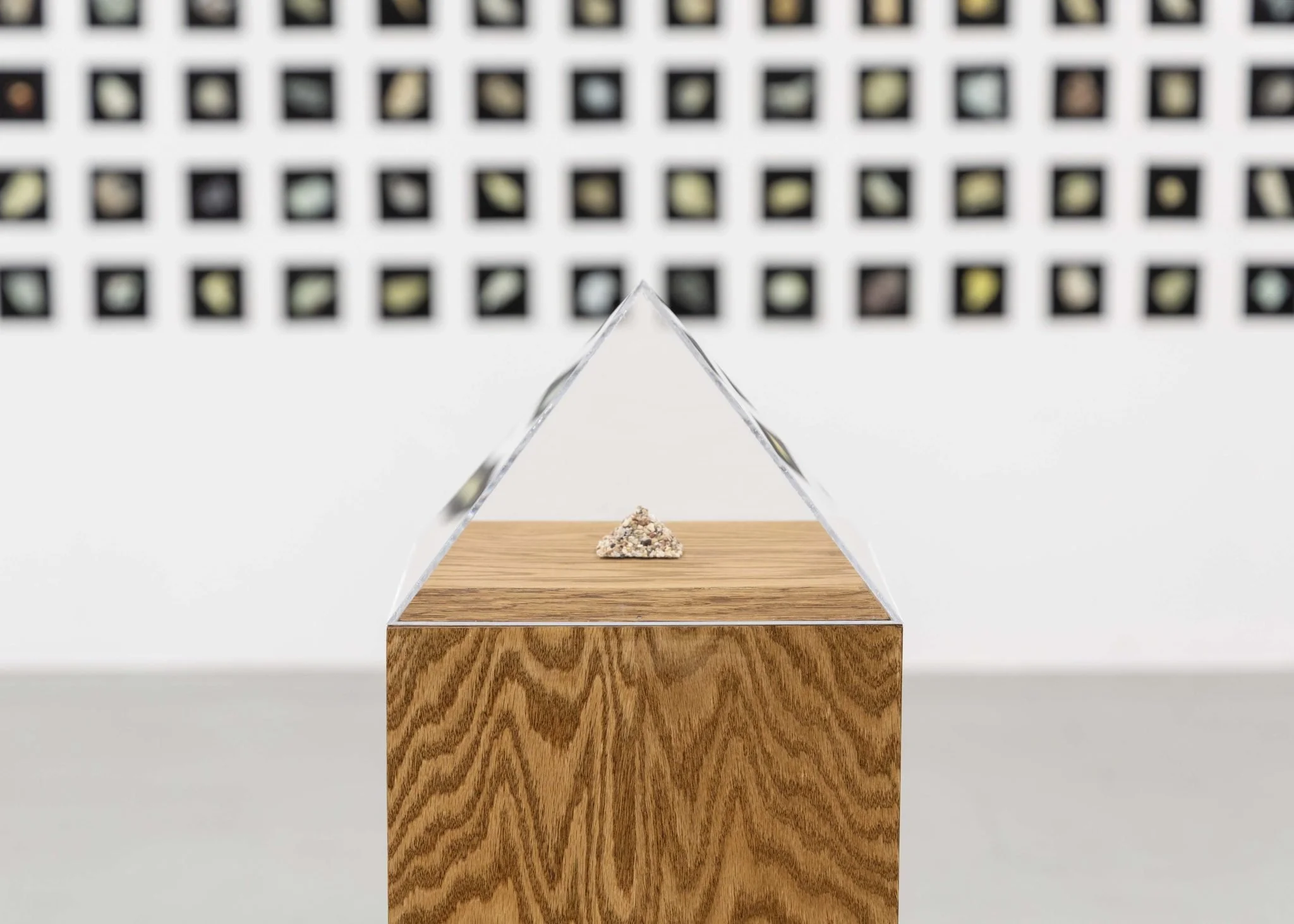
The sand-grain photos are arranged in a grid of ten rows that wrap around the gallery. In the center, sits a wood pedestal topped by a pyramid-shaped vitrine displaying a pyramidal sculpture made from every grain of sand in the photo installation. This sand pyramid, which measures two square inches at the base and one and a half inches high, is modeled on the Great Pyramid of Giza and scaled at 1:5,700 units of the original structure.
Hawthorn’s size and the bilaterally symmetrical layout support a visually balanced installation, giving the viewer adequate physical distance to take in so many photos without experiencing claustrophobia. Nevertheless, standing among the photos engenders an uncanny feeling, and even incredulity, as your eyes shift between the lilliputian pyramid and the wall-engulfing grid. It’s startling to see how many grains of sand are in a sample that would probably fill a quarter cup. Extrapolate that to all the sand grains on earth. The mental labor required to grasp that number is head-spinning. Also surprising is the realization that each grain of sand has unique characteristics. Could this mean that no two grains on earth are alike? It’s not something we routinely ponder while enjoying ourselves on the beach.
Like a paleontologist, Latiano photographs each grain on a black background, revealing that what we assume are nondescript bits of “rock” are actually fossils, primarily fragments of marine organisms such as coral, algae and sea creatures with shells. Some of the grains look like asteroids. The visual affinity illustrates how the very small and very large appear interchangeable from our perspective and also how commonplace objects, when magnified, are as foreign to us as objects from outer space—even when they’re literally beneath our feet. Moreover, the elements from which the shells and corals are made (calcium, carbon and oxygen) originate in stars, drawing yet another connection in the project between the microscopic and the cosmic and deep time and the present.
Just outside of the main gallery space hang four thirty-by-thirty-inch charcoal drawings of sand grains based on four of the installation’s photographs. By blowing up the size of the grains, Latiano invites closer scrutiny of their unique characteristics while downshifting even further the time required to analyze each grain. I was intrigued by the idea of Latiano continuing this series for every photo. Assuming he could complete a drawing per day, it would take him a little over six years—daunting yes, but not impossible.
Like so many other aspects of this profound exhibition, the drawings bridge art and science while alluding to different time scales and cycles, in this case, archeological and geological. Charcoal, of course, has been used by humans to make images for tens of thousands of years, frequently on sandstone, which is a sedimentary rock that forms when grains of sand are compressed over millions of years.
“Scaling a Pyramid” is gratifying on many levels, aesthetic, philosophical, experiential. As rigorous empirically as it is conceptually, it would be at home in a natural history museum as well as an art gallery. Perhaps what’s most rewarding about the project is watching Latiano wrap his arms around these huge concepts about time, space, scale, frames of reference, the interconnectedness of things and the narratives that materials and objects carry, and wrestle them down to earth. That it all started with a handful of sand is nothing short of astonishing.
(Published in Newcity, July 23, 2026)